How AI content engines work, and where the quality gate goes
An AI content engine runs research, outline, draft and review as separate stages. The quality gate belongs before publish, not after.

An AI content engine is a pipeline, not a single generation step
An AI content engine is a sequence of stages: research, outline, draft, review and publish. Each stage reads the prior stage's output and writes its own, as a structured file rather than a wall of prose. That separation is the whole point. A model can draft a competent paragraph in seconds, but a paragraph is not an article, and an article is not something you should publish unreviewed. The pipeline's job is to make every handoff between stages inspectable, so a weak draft gets caught at the outline or review stage instead of showing up live.
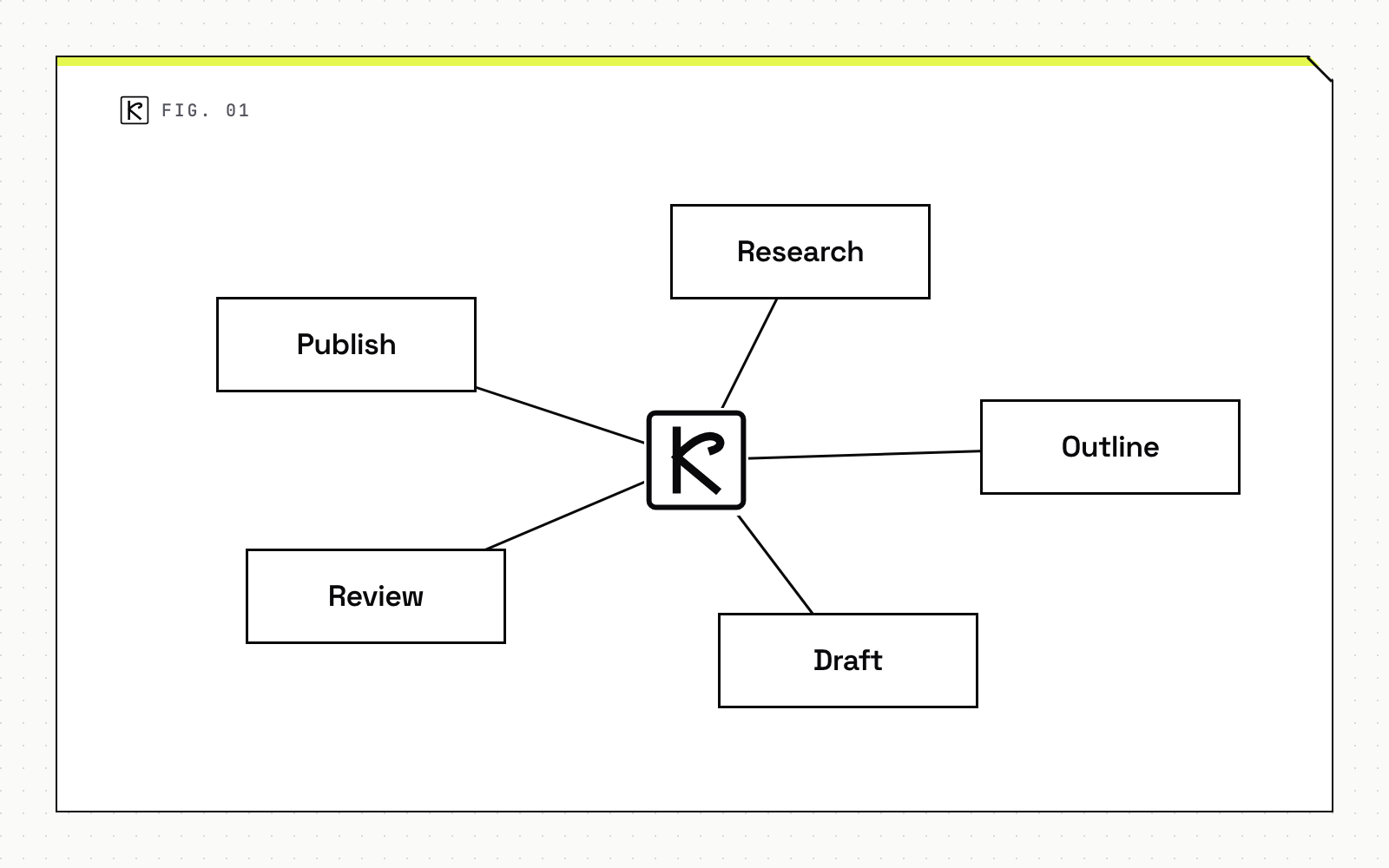
This matters for anyone evaluating whether to build or buy a content system, not just engineers. The question worth asking a vendor is not "which model do you use." It's "where does your pipeline stop a bad draft, and what does it check before it lets one through."
Treat each stage as a contract, not a conversation. Research produces a set of sourced claims, with a URL attached to each one. Outline turns those claims into a structure: headings, a target length, and a list of what still needs an internal or external link. Draft fills that structure in, citing back to the research. Review is where the pipeline either lets the draft through or sends it back. None of these stages needs to be a different tool. They need to be separable, so a failure in one doesn't quietly get absorbed by the next.
Why volume alone is a liability
The instinct with any automated system is to use it to produce more. With content, that instinct works against you. Google is explicit that automatically generating pages at scale without manual oversight or curation represents little to no effort, no matter how many pages come out the other end, as of its helpful content guidance updated October 2026. A high page count does not, by itself, improve a site's quality or relevance signal in Google's generative AI search features either.
There's a sharper version of this rule for near-duplicates. Producing a separate page for every variation of how someone might search, even when each page is technically unique, is classified as scaled content abuse and penalized independent of how well-written any single page is. A content engine built to ship volume for its own sake is optimizing for the wrong variable. One well-sourced article that's worth citing by AI answer engines beats ten thin ones chasing keyword variants.
Where the quality gate actually belongs
The gate belongs before publish, not after. A check that runs once content is already live and indexed only tells you what went wrong, after it's been crawled, possibly cited, and possibly seen by a reader. That's a postmortem, not a gate. The same logic applies to approval gates and audit logs on the access-control side of an AI system: the check that matters is the one that stops the action, not the one that logs it afterward.
In practice, a pipeline worth trusting chains three different kinds of checks, because each catches a different class of failure. Deterministic checks validate structure: required fields present, character limits respected, banned phrases absent. Fast, and they catch nothing subjective, which is exactly their value. Model-based judging, often called LLM-as-judge, scales the subjective part, scoring tone, clarity or factual framing the way a human editor would, but it carries a known limitation: it can reproduce the same blind spots and knowledge gaps as the model doing the judging. Human review stays necessary for the parts that neither of the first two can reliably catch, though it's also the step that doesn't scale once a pipeline is producing more than a handful of articles a week. The pattern that holds up is to run all three and block the run at the first failure, rather than leaning on any single one.
Authorship and freshness signals
Even a well-gated article needs to carry the right metadata for a reader, a search engine or an AI system to trust it. The core signals are author, headline, publication date and modification date. These four properties are what search engines and AI systems read to establish provenance and freshness, and they're the same fields that schema markup is built to carry. A pipeline that generates a clean article but skips the metadata hasn't finished the job.
Disclosure belongs in this same category. Google's own self-assessment for helpful content asks, directly, whether the use of automation is self-evident to a visitor through disclosure or other means. That's not a courtesy footnote. A content engine that can't answer that question for the pages it ships has a gap in its review step, not just its metadata.
A headline, an author field, a publication date and a modification date are four columns in a database row, nothing more exotic than that. The work is making sure the pipeline fills them in on every run, rather than leaving a placeholder that only gets noticed when a reader or a search console report flags it months later.
What this looks like for a small team
None of this requires a large team or a bespoke platform. It requires deciding, before any code gets written, what the pipeline's stages are and what each one is allowed to pass through. That's the same discipline covered in scoping an AI workflow automation project: define the stages, define what a failure looks like at each one, and decide who or what reviews the output before it's visible to anyone outside the team.
The model behind the drafting step is the least interesting part of this decision. It changes every few months, and the pipeline should be built so that it can. What doesn't change is the shape of the problem: research needs sources, an outline needs structure, a draft needs review, and nothing goes live until it clears a gate that checks more than one kind of thing. Teams at Kallos Labs that get asked to build a content system usually start there, because the gate is the part that's expensive to retrofit once a pipeline is already shipping pages. If you're scoping one of these for your own team, the AI automation work is a reasonable place to start that conversation.
Frequently asked questions
What is an AI content engine?
An AI content engine is a pipeline of discrete stages, typically research, outline, draft, review and publish, where each stage produces a structured artifact the next stage consumes. The model does the drafting work. The pipeline's job is to make every stage inspectable and to stop the run before a weak draft reaches a live page.
Does publishing more AI-written pages improve search visibility?
No. A high quantity of pages does not by itself improve a site's quality or relevance signal, and generating separate near-duplicate pages for every search variation is treated as scaled content abuse regardless of how the pages were produced.
Where should the quality gate sit in an automated pipeline?
Before publish, not after. A gate placed after content goes live only catches problems once they're already indexed and possibly cited elsewhere. The effective pattern chains deterministic checks for structure and required fields, a model-based review pass, and a human spot-check, and blocks the run at the first failure.
Is LLM-as-judge enough on its own?
No. LLM-as-judge scales well for subjective criteria like tone, but it can reproduce the same blind spots and biases as the model being judged. It belongs alongside deterministic checks and human review, not in place of them.