E-E-A-T explained for a company blog, 2026
E-E-A-T is Google's shorthand for experience, expertise, authoritativeness and trust. Here is what it is, what it is not, and what a company blog can do.

E-E-A-T stands for experience, expertise, authoritativeness and trustworthiness. Google uses it to describe helpful content. It is not a score, and it is not a switch you can flip. For a company blog it comes down to one question: can a reader tell who wrote this, why they should believe it, and how it was made?
What E-E-A-T stands for
E-E-A-T is a four-part description of content quality. Google's own page on creating helpful, reliable, people-first content spells out the acronym and gives two examples: content can be helpful "because of the experience it demonstrates" or because of the expertise it shares.
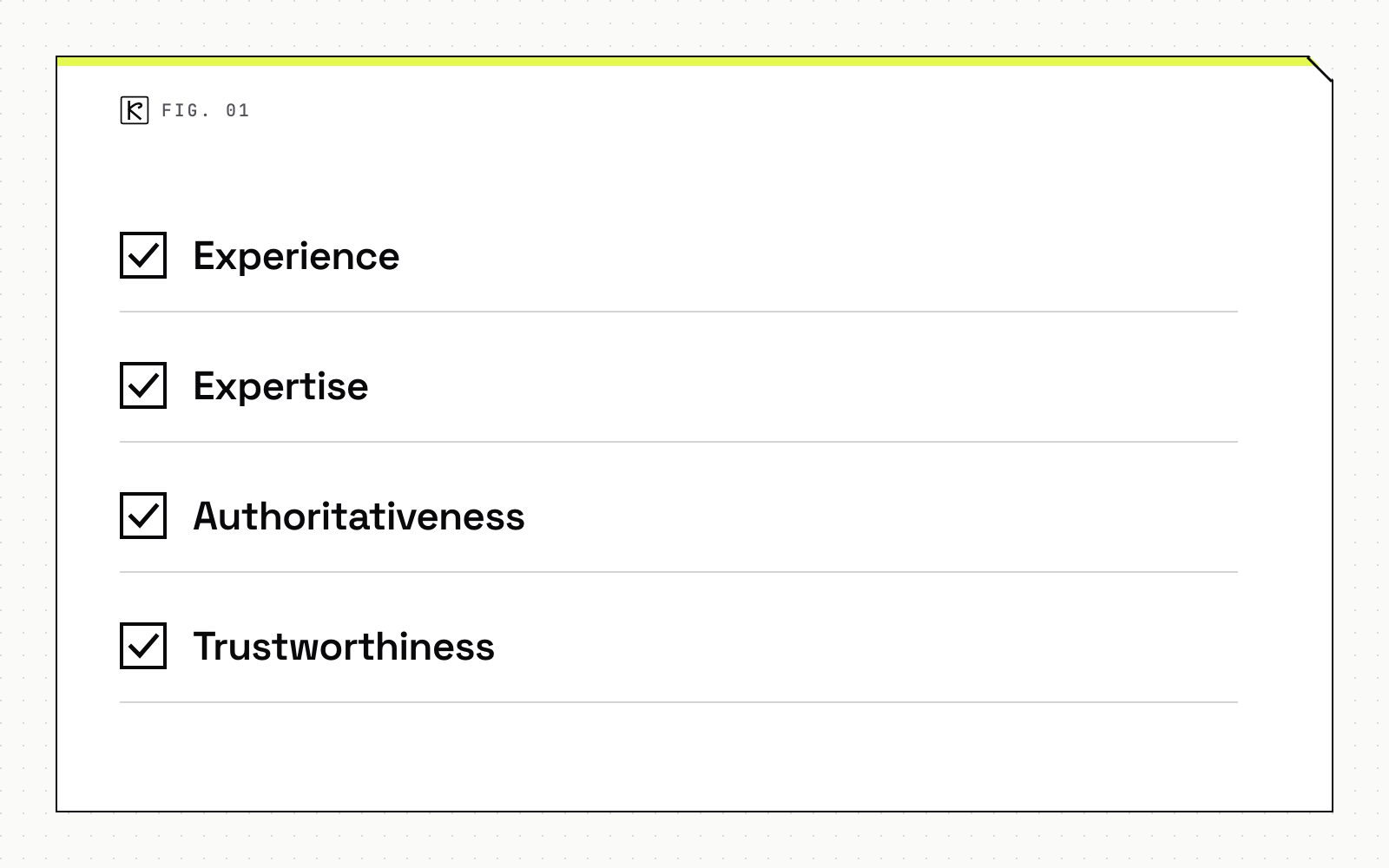
- Experience: the author has first-hand knowledge of the topic, such as having used the product or run the project.
- Expertise: the author or publisher knows the subject well enough to explain it accurately.
- Authoritativeness: the author or site is recognized as a go-to source on the topic.
- Trustworthiness: the page is accurate, honest and safe to rely on.
The first "E" is the newest. Google announced in December 2022 that its quality rater guidelines added Experience to the older E-A-T, as the title of its announcement puts it.
Why trust comes first
Google's guidance says it directly: "Of these aspects, trust is most important." The other three feed into it, and a page does not need to show all four. Search Engine Land's guide points to a rater guidelines example of weak experience: a restaurant review written by someone who never ate at the restaurant. That page can read well and still not earn trust.
For a company blog, that sets the priority. A named author with a modest bio and accurate, sourced claims beats a polished page with no visible person behind it.
Is E-E-A-T a ranking factor?
No, not in the way the name suggests. As of October 2026, Google's helpful content documentation says "E-E-A-T itself isn't a specific ranking factor." It also says search raters don't control rankings and that their data is not used directly in its ranking algorithms. There is no E-E-A-T score for your site.
The framework still matters because it describes what Google's systems are trying to reward. Ahrefs frames E-E-A-T signals as proxies and warns that they are imperfect and that improvements can take months to be recognized. Treat it as editorial hygiene, then measure SEO results in GA4 and Search Console over a long window instead of expecting a quick jump.
Who, how and why: Google's test for your posts
Google gives publishers three questions to ask of their own content. They are the most concrete part of its guidance.
- Who: make clear who created the content. Use bylines where readers would expect them and link them to author background. Google warns against fabricated creator profiles.
- How: explain how the content was produced, including any use of automation or AI, where readers might wonder.
- Why: content should exist primarily to help people, not to attract search visits. Google calls this perhaps the most important question.
If you can answer all three in a sentence each, most of the work is done.
In practice, "who" is a byline that links to a short author page. "How" is one line near the top or bottom of the post, such as "Written by our lead engineer and edited by our content lead; the benchmark figures come from our own test project." "Why" is the harder one, and it is an editorial choice more than a markup task: if a post exists only to catch a keyword, no byline will rescue it. A useful test is to ask whether a customer who found the post through search would be glad they landed there.
Where E-E-A-T shows up beyond the article
Readers and raters judge the site, not just the post. A strong article on a site with no About page, no contact route and no sign of who runs it still asks the reader to take a lot on faith. The reverse also holds: a modest post on a site that is clearly run by identifiable people, with dated pages and cited sources, starts with more credit. Check the pages around your blog before you rewrite the blog itself.
What a company blog can show
Most company blogs miss the visible basics. Subtle signals rarely come into it. Ahrefs lists practical steps for each letter, and they translate well to a business site.
Experience and expertise
- Share first-hand material: case studies, lessons from mistakes, original screenshots or photos, a note on how the piece was made.
- Publish real author bios with credentials and links to a professional profile.
- Link to primary sources and cite experts. When we write about a platform rule, we link the platform's own documentation and quote it where the wording matters.
- For health or finance topics, have a qualified expert review the page and credit them.
Authoritativeness and trust
- Keep a clear About page, working contact details and a privacy policy, on HTTPS across the whole site.
- Show publish and update dates, and update old posts when facts change. A plan to refresh, merge or delete old posts keeps those dates honest.
- Label sponsored and affiliate content clearly.
- Consider an editorial standards page that explains how you fact-check and handle corrections.
- Earn mentions with original research, talks and interviews, then list them on a press page.
What not to do
Don't invent a byline, a credential or a client story. Google's guidance warns against fabricated creator profiles, and a made-up case study fails the trust test faster than a thin one. Don't hide AI assistance, either. Ahrefs notes that AI-assisted content is not penalized by itself, and recommends human review, added first-hand insight and fact-checking. Disclosure is the "how" in Google's test.
Don't treat the acronym as a checklist, either. Adding "expert" labels to pages does nothing if the content underneath is generic.
A short checklist
- Every post has a named author with a bio page.
- Every factual claim links to its primary source.
- Every post shows a publish date and an update date.
- At least some posts carry first-hand material only your team has.
- The About, contact and privacy pages exist and are linked in the footer.
- Posts are written so each section stands alone, which also helps structuring content so it can be retrieved and cited.
If you want a second pair of eyes on how your blog presents authors and sources, see our SEO and AEO service.
Conclusion
E-E-A-T is a description of good publishing, not a lever. Put a real person on each post, source your claims, say how the content was made, and keep it current. Trust is the center of it, and trust is mostly earned by being easy to verify.
Frequently asked questions
Is E-E-A-T a ranking factor?
No. Google says E-E-A-T itself isn't a specific ranking factor, and there is no E-E-A-T score. It is a framework for describing helpful content, and rater data is not used directly in ranking algorithms.
Do I need to show all four elements on every page?
No. Google says content can be helpful because of the experience it shows or the expertise it shares. Trust is the element that matters most, so make sure every page is accurate and clear about who is behind it.
Does using AI to write posts hurt E-E-A-T?
Not by itself. Google asks publishers to be clear about how content was produced, and Ahrefs recommends human review, first-hand input and fact-checking for AI-assisted work.
How long until changes to author pages and sources show results?
Possibly months. Ahrefs notes that improvements can take a long time to be recognized, so treat this as ongoing editorial work, not a one-off fix.