Zero click search in 2026: how to win when the answer is on the results page
68.01% of US Google searches ended without a click in early 2026. What the number means, what Google says it takes to appear in AI answers, and how to measure demand instead of visits.

Most Google searches now end on the results page, and the share keeps rising. SparkToro found that 68.01% of US Google searches ended without a click in the first four months of 2026, so winning means being chosen by name, finishing the visitor's task on your site, and measuring demand instead of visits.
A zero click search is a search where the person gets what they need from the results page and clicks no result. This guide covers what the 68% figure does and does not say, what Google documents about appearing in AI answers, and three changes that hold up when clicks fall. It is written for marketing leads and founders who have to decide where the next dollar goes.
What the 68% figure does and does not tell you
The headline number comes from SparkToro's 2026 study, which used Similarweb's desktop and mobile clickstream panel. It covers US searches from January to April 2026 and found that 68.01% ended without a click.
Read it with its caveats
The study is open about its limits, and you should be too when you quote it:
- The earlier figures came from other panels. SparkToro reports 60.45% for 2024 (Datos) and about 49% for 2019 (Jumpshot). The author calls the comparison "apples and oranges," so treat the trend as a direction, not a precise slope.
- The mobile and desktop split is an estimate of roughly two thirds mobile and one third desktop.
- Mobile search sessions were assumed to end after 10 seconds of inactivity.
- The data excludes the Google mobile app, so the true share may be higher.
None of this makes the number wrong. It does mean you should say "about two thirds of US Google searches, per one 2026 panel study" and not present it as a law of nature.
Where AI Overviews fit
The same study cites Ahrefs data that AI Overviews appear on more than 20% of searches and reduce click-through rate by nearly 60% when they are present. AI Mode was a much smaller factor: only 0.34% of searches reached it between January and April 2026. For a closer look at the click data, see our write-up on what the click-through data shows for AI Overviews.
What Google says it takes to appear in AI answers
Google's documentation is brief on this point. As of its December 2025 update, AI features and your website says a page must be "indexed and eligible to be shown in Google Search with a snippet." It adds that there are no additional technical requirements for AI Overviews or AI Mode.
That has three practical consequences:
- You do not need special schema.org markup for AI features.
- You do not need new machine-readable files or AI-specific text files.
- Meeting every requirement still does not guarantee that Google will crawl, index or serve a page.
You can limit how your content appears with nosnippet, data-nosnippet, max-snippet or noindex. Google-Extended covers limiting AI training and grounding in some other Google systems. Be deliberate here: a page that shows no snippet is a page with less chance of being used.
The takeaway is plain: technical eligibility is the floor, and most sites already clear it. What separates pages is whether the content is worth quoting and whether the brand is worth seeking out, which is where the rest of this article goes.
Become a destination that finishes the job
If an answer fits in a sentence, Google will show it and the click disappears. If the visitor needs to do something, the click survives.
SparkToro's follow-up, what still works when Google stops sending clicks, cites Cyrus Shepard's analysis of more than 400 winning and losing sites. Nearly 84% of the winners let users finish what they came to do, against about half of the losers. Sites with four or five of the winning characteristics won about 68% to 70% of the time, compared with 15% for sites with only one.
In practice, that means looking at each page that earns impressions and asking what the visitor can complete there:
- A pricing explainer becomes a calculator or a scoping form.
- A "how to check" article becomes the checker.
- A comparison page becomes a tool that takes the visitor's own inputs.
- A local information page becomes a way to book, order or reserve.
Pages that only define a term are the most exposed. A results page can define a term without sending anyone anywhere. Keep them accurate, since the same study notes that site content still shapes AI answers, but do not expect them to carry traffic on their own.
Make the brand the reason people come back
SparkToro's tactics article puts branded terms at about 44% of Google searches, and reports that strong-brand sites won at roughly twice the rate of other sites in the Shepard analysis. Its advice is to become "a named entity" instead of trying to get a pile of pages to rank.
That changes where effort goes:
- Own the audience. An email list, a community and first-party data are the assets that no platform can revoke.
- Show up where your audience already pays attention, including platforms you do not own, without fixating on whether each mention carries a link.
- Keep your name, category and claims consistent across your site and profiles. We cover that in making your brand unambiguous to search engines and LLMs.
Search still pays off for branded queries, local businesses and high-intent transactional searches. The shift is in what you expect from broad informational queries.
Measure demand, not just visits
If the scoreboard is sessions from organic search, a rising zero-click share will always look like failure. Two changes make the picture honest.
Use the reporting Google gives you
AI Overviews and AI Mode traffic is counted in Search Console's Performance report under the Web search type, per Google's documentation. In June 2026, Google also announced Search Generative AI performance reports in Search Console, which break out impressions inside generative AI features. Access is limited: it is rolling out to a subset of sites, so check whether your property has it before building a process around it. Our guide to how to measure SEO results with GA4 and Search Console covers the baseline setup.
Add a correlation dashboard
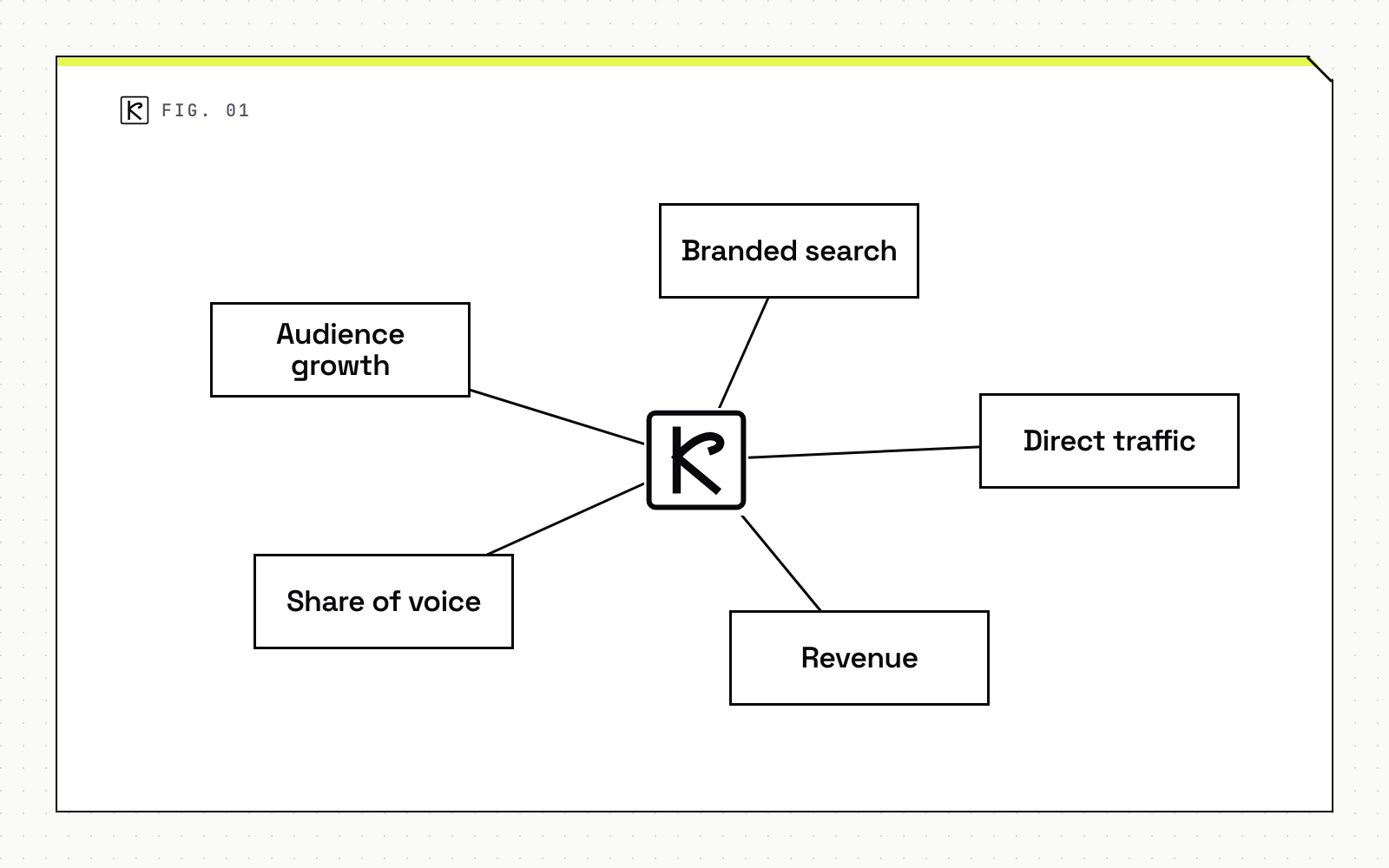
SparkToro suggests retiring traffic as the single scoreboard and tracking proxies for demand next to it: branded search, direct traffic, revenue, share of voice and audience growth. None of these proves cause on its own. Read together over a few months, they show whether people are finding and choosing you, even when the click happened somewhere you cannot see. You can also track AI citations and brand mentions to fill in the share-of-voice line.
What to do this quarter
Zero click search is a measurement and positioning problem more than a technical one. Google says there's nothing special to add for AI features, so the work is elsewhere:
- Pick the five pages with the most impressions and give each one a task the visitor can complete.
- Add branded search, direct traffic and revenue to your reporting next to organic sessions.
- Check whether Search Console shows the Generative AI performance report for your property.
- Decide which owned channel (email, community, first-party data) takes the attention that search no longer hands you.
If you want a second pair of eyes on how your site turns impressions into outcomes, talk to Kallos Labs.
Frequently asked questions
What is zero click search?
A zero click search is a search that ends on the results page without a click to any result. SparkToro's 2026 study counted 68.01% of US Google searches that way from January to April 2026, using Similarweb panel data.
Do I need special markup or an llms.txt file to appear in AI Overviews?
No, according to Google. Its documentation says a page must be indexed and eligible to show a snippet, with no additional technical requirements, no special schema.org structured data and no new AI text files. Appearing is still not guaranteed.
Can I see AI Overviews traffic in Search Console?
Yes. Google says AI Overviews and AI Mode traffic is included in the Performance report under the Web search type. A newer Generative AI performance report, announced in June 2026, breaks out impressions in those features and is rolling out to a subset of sites.
Is the 68% number comparable to earlier years?
Only loosely. The 2019, 2024 and 2026 figures come from different panels, and the study's author calls the comparison "apples and oranges." Use the trend as a direction, not as an exact measurement.