AI agent guardrails: permissions, approval gates and audit logs
AI agent guardrails are permission scopes, approval gates and audit logs enforced outside the model. Here is how to set them up, and where teams go wrong.

Direct answer
AI agent guardrails come down to three separate controls: narrow permission scopes on the tools an agent can call, approval gates that pause it before an irreversible action, and audit logs that record what it actually did. None of the three lives inside the model. As of the 2026 OWASP Top 10 for LLM Applications, Excessive Agency jumped from sixth place to third, the largest move in the new ranking. More agents now hold real tool access and real permissions. So if you're giving an agent write access to a database, a payment flow, or outbound messaging, these three controls are what stand between a wrong output and a wrong action.
Before you start
An agent, in this context, is a model plus a set of tools it can invoke on its own, without a person approving each call in advance. The Model Context Protocol has become the common way to expose those tools to a model in a structured, discoverable form. That structure is also what makes it possible to gate tools consistently, instead of bolting on a check for each integration one at a time.
It helps to separate this from a related but different concern. Retrieval-augmented generation is about what the model reads before it answers. Guardrails are about what it's allowed to do once it decides to act. A support agent with perfect retrieval and an unscoped refund tool is still a risk. A support agent with no retrieval at all, but a properly scoped, approval-gated tool set, is not.
Underneath all three guardrails sits one rule, stated plainly in the MCP specification: there should always be a human in the loop with the ability to deny a tool invocation. Permissions, approval gates and audit logs are three different points where that rule actually gets enforced: before the call is even possible, at the moment of the call, and after it.
Step-by-step: build the three guardrails
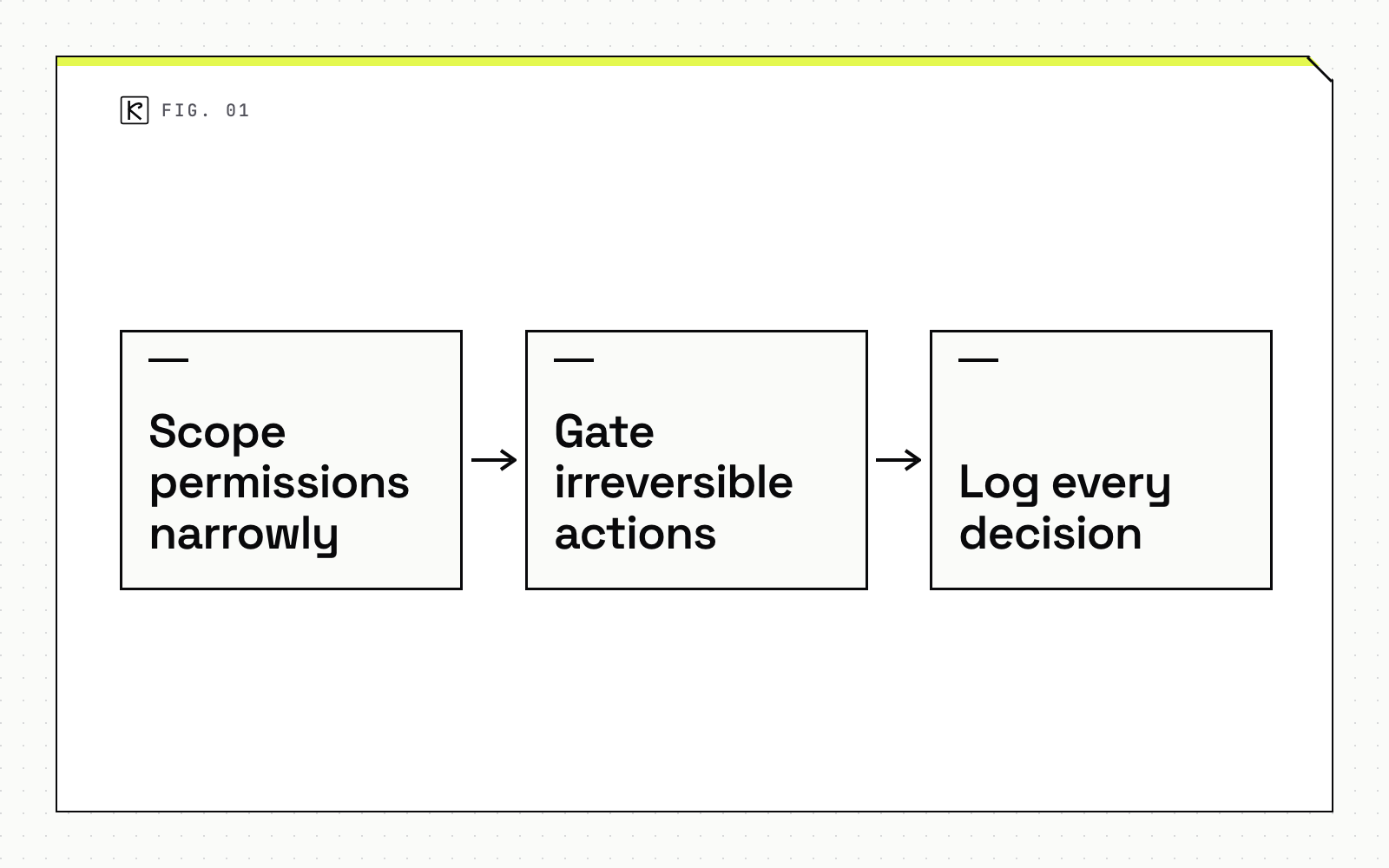
Step 1: scope permissions narrowly, not by prompt. The most reliable guardrail is the one that makes an action impossible to take, not just unlikely. That means splitting read, write, delete, export and send into separate, individually grantable permissions rather than one broad tool. Why? Because a tool that was never registered can't be called no matter what the prompt says. A meeting-prep agent gets read access to email. It doesn't also get delete and send just because the underlying API happens to bundle them together.
The same idea applies one layer down, at the data store itself. Row level security enforces that same narrow-scope principle at the database, so even a compromised or confused agent call gets checked against a policy the agent can't see or override. Tool annotations like readOnlyHint, destructiveHint, idempotentHint and openWorldHint can feed a policy engine that flags what needs a closer look, but they're hints a server reports about itself, not enforcement, and an untrusted server can simply misreport them.
Step 2: gate irreversible actions on a real approval. Some actions can't be undone: payments, production deletes, credential rotation, sending a message to someone outside the organization. These need a human checkpoint, not a confidence threshold. A workable pattern is graduated response: automatically deny anything clearly out of policy and log the reason, automatically approve routine actions under a defined threshold, and route everything else to a person. Here's the part teams tend to skip: making the approval itself unforgeable. The record of who approved what has to be signed, so a client can't replay its own message history later and manufacture a sign-off that never happened.
Step 3: log every decision at one control point, not per tool. The MCP specification is direct about this too. Clients should log tool usage for audit purposes. The useful version of that logging sits at a single control point, capturing latency, which guardrail fired, and the outcome, rather than scattered across a dozen separate integrations where an incident review has to reconstruct the timeline by hand. Pair this with hard ceilings enforced before the next model call, not after the spend has already happened: a default step limit, and separate budgets for retries, elapsed time, tool calls and provider cost.
Common mistakes
The mistake underneath most of the others: letting the model judge whether its own action is authorized. It can't. OWASP is explicit that authorization has to sit downstream of the model, enforced independently of whatever the LLM concluded, because a hallucinated or manipulated output is exactly the trigger that turns a permission meant to be narrow into actual damage.
A second mistake is treating a tool annotation as a guarantee. destructiveHint and readOnlyHint are useful signals from a trusted server. They aren't a security boundary, and a buggy or malicious one can misreport them without anything downstream noticing, until the log does.
A third: building one do-everything tool instead of scoping read, write, delete and send separately. It's convenient during development, and it means a single prompt injection has a far larger blast radius than the task ever needed.
A fourth is logging without alerting. A log nobody reviews until after an incident isn't a guardrail. It's an autopsy report.
The 2026 OWASP ranking move, sixth place to third, is the industry-scale version of the same mistake: agent deployments outran the guardrails meant to contain them. It's also why the project's newly donated Agent Control Standard exists at all, covering identity, governance, testing and runtime controls as a shared baseline instead of leaving each team to reinvent one. Kallos Labs builds this same review pass, scoped permissions, a signed approval step and a single audit log, into every AI agent and automation project it ships.
Frequently asked questions
What are AI agent guardrails?
AI agent guardrails are the permission scopes, approval checkpoints and logging controls that limit what an autonomous agent can do and create a record of what it did, enforced outside the model itself rather than by asking it to behave.
What is an approval gate in an AI agent workflow?
An approval gate is a checkpoint that pauses an agent before an irreversible action, a payment, a production delete, a credential rotation, an outbound message, until a human confirms it, with the confirmation recorded so it cannot be forged or replayed later.
Do audit logs stop an AI agent from taking a bad action?
No. An audit log doesn't block anything by itself. It's the durable record that makes a permission scope or approval decision attributable after the fact, and pairing it with rate limits and anomaly alerts is what turns logging into a control rather than paperwork.
Why is excessive agency a top AI security risk in 2026?
OWASP's 2026 Top 10 for LLM Applications moved excessive agency from sixth to third place because production incidents increasingly involve agents that hold real tool access and real permissions. A manipulated or hallucinated output can trigger a genuine action instead of just a bad response.
Conclusion
Permissions, approval gates and audit logs are three separate controls, not one setting, and the model's own judgment is not one of them. Scope tools narrowly. Gate the irreversible ones on a signed human approval. Log every decision at a single point you actually review. The OWASP Agent Control Standard donated in 2026 is the first attempt at a shared spec for identity, governance, testing and runtime controls across agent frameworks. It's worth watching as it matures, and worth building toward now.