AEO audit checklist: 20 checks for your site, 2026
A 20-point AEO audit checklist: bot access, indexability, passage structure, markup and measurement, with each rule tied to its primary source.
An AEO audit checks three things: whether search and AI bots can reach your pages, whether each page answers a question in a passage that stands alone, and whether your markup and measurement match what is on the page. Google says there are no additional requirements to appear in AI Overviews or AI Mode, "nor other special optimizations necessary", so most of this list is ordinary search hygiene.
The checklist below has 20 items. Each one is marked as a platform rule (with the source linked) or as our practice, which is a judgment call and not a requirement from any platform. Sources were last checked on October 30, 2026, and the Google pages cited were last updated on December 10, 2025.
Access: can the bots reach the page
Start here. A page a bot can't fetch can't be cited. Pull your robots.txt, your CDN or firewall bot rules and a week of server logs before you begin, because most access failures hide in the layer in front of the application and not in the code of the site itself.
1. Googlebot is allowed in robots.txt and at the CDN or host. Google lists allowing crawling in robots.txt, "and by any CDN or hosting infrastructure" as a best practice for AI features. Test the live robots.txt and a real page request, not just the file.
2. OAI-SearchBot is allowed if you want to appear in ChatGPT search. OpenAI states that sites opted out of OAI-SearchBot will not be shown in ChatGPT search answers, though they can still appear as navigational links. Platform rule.
3. The GPTBot decision is made on its own. GPTBot is the training crawler, and OpenAI describes the two settings as independent: a site can allow OAI-SearchBot and disallow GPTBot. Write down which you chose and why.
4. The Anthropic bots are each decided. Anthropic describes three bots: ClaudeBot for training data, Claude-SearchBot for search quality, and Claude-User for user-initiated requests. Blocking the last two may reduce your visibility in Claude's search results.
5. You do not block AI bots by IP address. Anthropic warns that blocking its IP addresses may not work and can stop it from reading your robots.txt. Use robots.txt rules instead.
6. You do not rely on robots.txt for user-initiated fetches. OpenAI notes that for ChatGPT-User, which fetches a page when a person asks, robots.txt rules may not apply. Treat it as a visit by a reader.
7. You allow a day for changes to land. OpenAI says it can take about 24 hours after a robots.txt update for its search systems to adjust. Do not judge a change on the same afternoon, and record the date of each edit so a later drop in visibility can be traced to it.
For the wider picture of who crawls what, see our piece on robots.txt choices for AI crawlers.
Indexability: is the content in the page
8. Important content is text in the delivered HTML. Google asks you to keep important content in text form. Fetch the page without scripts and read what is there.
9. Answer pages return 200 and carry no stray noindex. Check status codes and robots meta tags on every page you want cited. Platform rule, because AI features draw on pages in Google's Search index.
10. Snippet controls are set on purpose. Google names nosnippet, data-nosnippet, max-snippet and noindex as the controls that limit what is shown. If a control seems ignored, check the HTML Googlebot received in the URL Inspection tool, then allow time for a recrawl.
11. Internal links reach every answer page. Google lists making content findable through internal links as a best practice. Orphan pages are the usual failure. A crawl of your own site that lists pages with zero inbound internal links will find them in minutes.
12. Answer pages are in the XML sitemap. Our practice. A sitemap doesn't guarantee indexing, but it's the cheapest list to audit against.
Structure: can a passage stand alone
These four are our practice, not platform rules. Retrieval systems pull passages, so a paragraph that only makes sense after three others is a weak candidate.
13. The first two or three sentences answer the title question. If the answer sits in paragraph six, move it up. 14. Headings are descriptive. "Access: can the bots reach the page" works. "Under the hood" does not.
15. Each paragraph is self-contained, with one flat definition per key term. Name the subject in the sentence instead of writing "it" across a paragraph break. Our article on headings, chunks and paragraphs goes deeper.
16. Claims carry a date and a named source. A figure with no date and no link is hard to trust, for a reader or a system.
Markup: does it match the page
17. Structured data is valid and uses JSON-LD where your setup allows. Google says it recommends JSON-LD in general. Microdata and RDFa are accepted if valid.
18. Every marked-up fact is visible on the page. Google's rule, quoted: "don't add structured data about information that is not visible to the user, even if the information is accurate." That includes FAQ markup, which should exist only where the questions and answers are shown.
19. You have not added special markup for AI. Google states there is no special schema.org structured data you need to add for AI features. Spend that time on item 18 instead.
Measurement
20. You have a baseline, and you log manual checks by date. Google reports AI feature traffic in the Search Console Performance report under the Web search type, so there is no separate AI report to open. For other assistants there is no official citation report, so keep a dated log of the questions you test and what each assistant answers. See tracking AI citations and brand mentions for a method.
How to prioritize
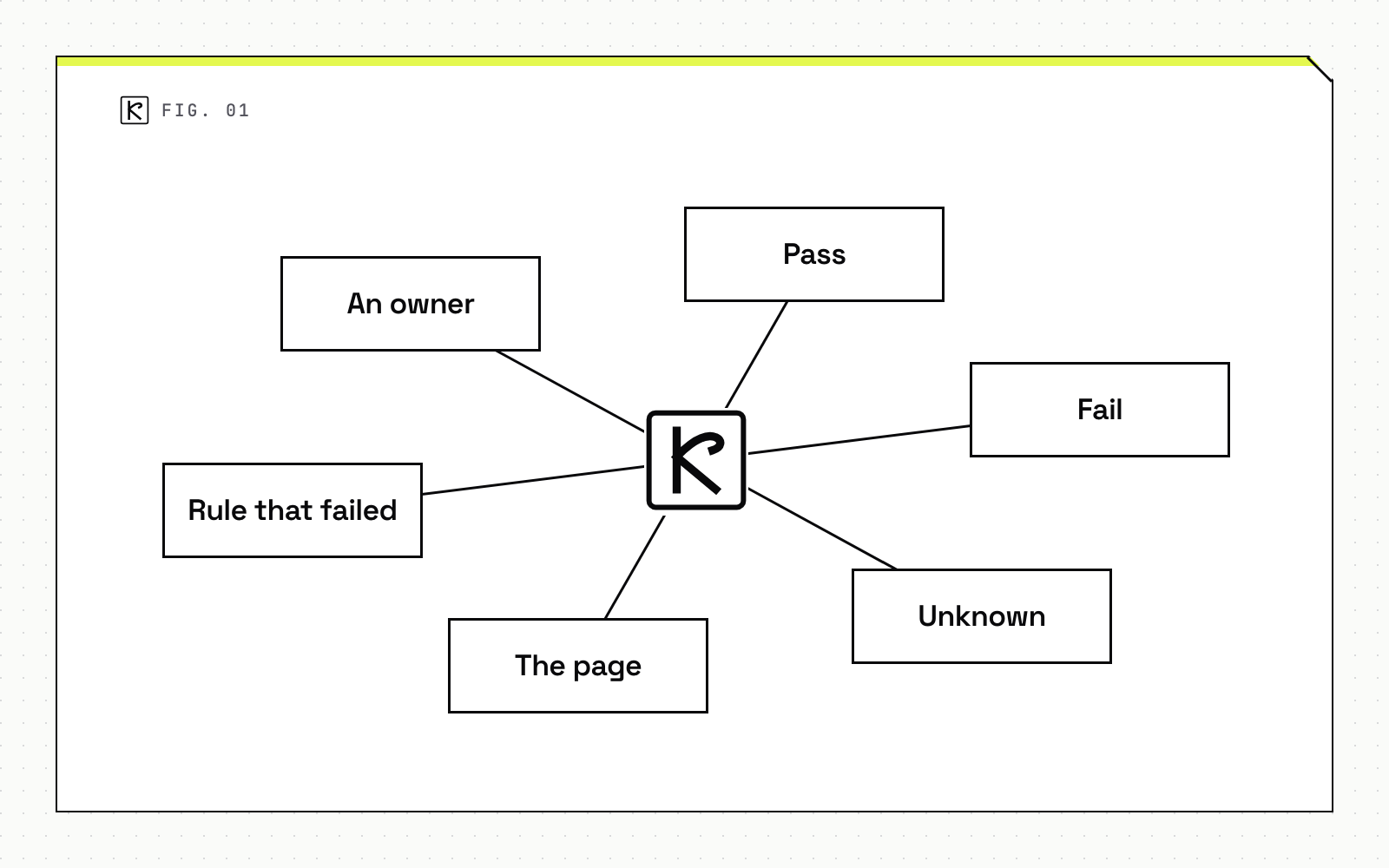
Work top to bottom, and keep a simple sheet with one row per item: pass, fail or unknown, the page or rule that failed, and an owner. Access failures (items 1 to 7) cancel everything below them, so fix those first. Indexability comes next, then passage structure, then markup, then measurement. Items 13 to 16 and 20 are our practice, so treat them as good editing and not as ranking rules, since no platform has published a formula for being cited.
If you want a second pair of eyes on the result, the SEO and AEO service at Kallos Labs covers this kind of audit. Run the checklist again after any migration, CDN change or robots.txt edit, and at least once a quarter.
Frequently asked questions
Is special schema.org markup required for AI Overviews?
No. Google's AI features documentation says there is no special schema.org structured data you need to add. Keep your markup valid and matching the visible text.
Does blocking GPTBot remove my site from ChatGPT search?
No. OpenAI treats GPTBot, the training crawler, and OAI-SearchBot, the search crawler, as independent robots.txt settings. Disallowing GPTBot does not by itself opt you out of search.
How do I see AI Overview traffic?
Google reports it inside the Search Console Performance report under the Web search type. There is no separate AI Overviews report, so compare periods in the same report.
How often should I run this audit?
We suggest quarterly, and after any migration, CDN change or robots.txt edit. That cadence is our judgment, not a platform rule.