Autonomous vs assisted AI: which one your workflow needs, 2026
Assisted AI follows steps you define. Autonomous AI chooses its own. Use the least autonomy that works, then add more only when measured gains justify it.

If you can write the steps of a task down in advance, you need assisted AI: a model that works inside a path you control. If you cannot, and the next step depends on what the model finds along the way, you may need autonomous AI. Most workflows sit on the first side of that line, and the cost of guessing wrong is real.
This article defines both terms, gives a test for choosing, and covers what autonomy costs, where a person should stay involved, and how to move from one to the other safely.
Assisted and autonomous AI, defined
Assisted AI means a person or fixed code decides each step, and the model helps inside that step. Autonomous AI means the model decides the steps itself. Neither term names a product category. Both describe who holds control.
Assisted: you or fixed code choose the steps
Anthropic's engineering guidance on building effective agents calls these workflows: "systems where LLMs and tools are orchestrated through predefined code paths." The sequence is fixed. The model might classify a message, draft a reply or extract fields from an invoice, but your code decides what happens before and after.
Autonomous: the model chooses the steps
The same source defines agents as "systems where LLMs dynamically direct their own processes and tool usage, maintaining control over how they accomplish tasks." The model picks a tool, reads the result, and decides what to do next until it judges the goal met or hits a stop condition.
A spectrum, not a switch
Between a single model call and a free-running agent there is a lot of room. A single call with retrieval and examples is the simplest option. A fixed chain of calls is next. An agent that pauses at checkpoints for a person is further along. Pick a point on that spectrum per task, not per company.
The test: can you write the steps down?
Write the task as a numbered list. If you can do that without saying "it depends on what we find," the path is known, and assisted AI fits.
Anthropic frames the same boundary: agents suit open-ended problems, where "you can't hardcode a fixed path." Its advice for everything else is to "find the simplest solution possible, and only increase complexity when needed." It adds that for many applications, optimizing single LLM calls with retrieval and in-context examples is usually enough.
Two examples show the difference:
- Assisted fit: sorting inbound support tickets by topic, drafting a reply from your help center, and sending it to a person for approval. The steps never change, so you gain nothing by letting the model choose them.
- Autonomous candidate: investigating why a metric dropped across several systems, where each finding decides which system to query next. The path cannot be written ahead of time.
Not sure? Treat the task as assisted first. You can loosen control later. Tightening control after an agent has already acted on live systems is much harder.
What autonomy costs
Autonomy is not free, and the price shows up in three places.
Latency and money. Anthropic notes that "agentic systems often trade latency and cost for better task performance." Every extra decision is another model call, and an agent may take many of them. If a task is worth a few seconds and a few cents, an open-ended loop can break that budget. Our guide to tokens, caching and model routing covers how to keep that spend in check.
Compounding errors. The same post warns of "the potential for compounding errors." A small mistake in step two feeds step three, and by step eight the result can be far from what you wanted. Anthropic recommends extensive testing in sandboxed environments and appropriate guardrails.
Harder debugging. Anthropic also cautions that framework abstractions can "obscure the underlying prompts and responses, making them harder to debug." The more the model decides, the more you need to see exactly what it was asked and what it answered.
Agents aren't a bad idea. Autonomy just has to earn its place with a measured gain.
Where a person stays in the loop
Even teams running agents in production rarely let them run free. A December 2025 study, Measuring Agents in Production, combined 20 case studies with a survey of 86 practitioners across 26 domains. It found that 68% of production agents execute at most 10 steps before human intervention, and 74% depend primarily on human evaluation. The authors also report that reliability remains the top development challenge.

Safety guidance points the same way. OpenAI's guidance on building agents advises keeping tool approvals enabled, so a person can review and confirm every operation, reads and writes included. It also notes that the built-in guardrails "alone are not foolproof," and that a model can leak private data "without an attacker behind it." Prompt injection is a separate risk: untrusted text that enters the system can try to override your instructions.
In practice, that gives you three controls:
- Approval gates before any action that is hard to undo, such as sending a message, spending money or changing records.
- Stop conditions such as a maximum number of iterations. Anthropic lists these as a way to maintain control.
- Checkpoints where the agent pauses for human feedback or when it hits a blocker.
For a deeper look at deciding which actions need approval, see which agent actions need a person.
Start simple, then graduate
The safest order is the one the sources above point to:
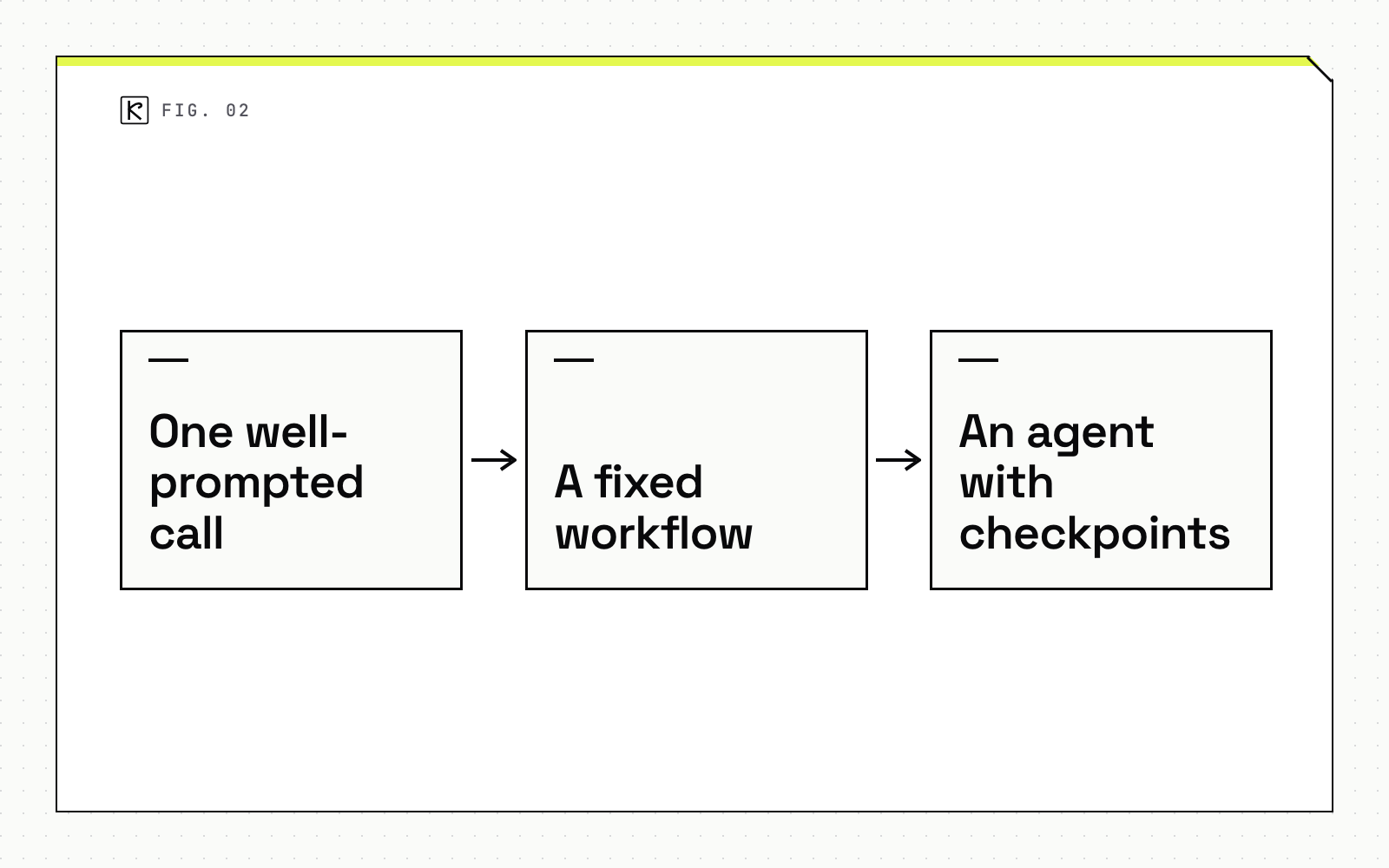
- One well-prompted call with retrieval and examples. Measure it.
- A fixed workflow of several calls, if one call is not enough.
- An agent with checkpoints, only where the path truly cannot be written down and the measured gain beats the added cost and risk.
At each step, you need a way to tell better from worse. That means a set of real test cases with expected outcomes. Our walkthrough on how to build an eval set before you ship shows how to create one. Without it, "the agent seems better" is a feeling, not a result.
If you are scoping this for a product, a team such as Kallos Labs can help you map each task to the right level of control during AI automation planning.
The bottom line
Choose the least autonomy that does the job. Use assisted AI when you can write the steps down, and reserve autonomous AI for open-ended problems where a fixed path will not work. Keep a person in the loop for actions that are hard to reverse, set stop conditions, and measure every step up in autonomy against a test set. Don't aim for the most capable-looking system. Aim for the one you can predict, afford and fix.
Frequently asked questions
What is the difference between autonomous and assisted AI?
In assisted AI, a person or a fixed code path decides each step and the model helps inside it. In autonomous AI, the model chooses its own steps and tool calls toward a goal. Anthropic draws the same line between workflows, which use predefined code paths, and agents, which direct their own process.
Is an autonomous agent always better than an assisted workflow?
No. Agentic systems often trade latency and cost for better task performance, and autonomy brings the potential for compounding errors. When the steps are known in advance, a fixed workflow is usually cheaper, faster and easier to test.
Do autonomous AI systems still need human oversight?
Yes. In a December 2025 study of production agents, 68% executed at most 10 steps before human intervention and 74% relied primarily on human evaluation. OpenAI also advises keeping tool approvals enabled so a person can confirm each operation.
Can I start assisted and move to autonomous later?
Yes, and that is the safer order. Start with a single model call or a fixed workflow, measure it against an eval set, and give the model more control only where the measured gain justifies the added cost and risk.